
What This Process Does
Creates Rates on the Client level to add to Gross Definitions to pay on employee jobs.
Best Practices
A new rate master can be added, but the most efficient way to add a new rate master is selecting an existing Rate Master that is most similar, changing the Rate ID field to a new unique ID, make any necessary changes for the rate and save.
Requirements
- When new Rate Masters are added, payroll program updates must be run to add the rates to the Payroll Register.
- Rate IDs have requirements to reflect on pay stubs:
- Salary amounts on the stub must have rates that are "SALARY", "EXTENDED DAY", "EXTENDED YEAR", "EXTENDED YEARNI" or contain "SUPPL"
- Unit amounts must have rates that contain "HOURLY", "DAILY", "UNIT" or "MEETING"
- Overtime amounts must have rates that start with "OVERTIME".
- Other unit rates outside of those mentioned above would reflect in the Adjustments column
Add Rate Master
1. Position Tracking → Setup → Rates → Rate Masters
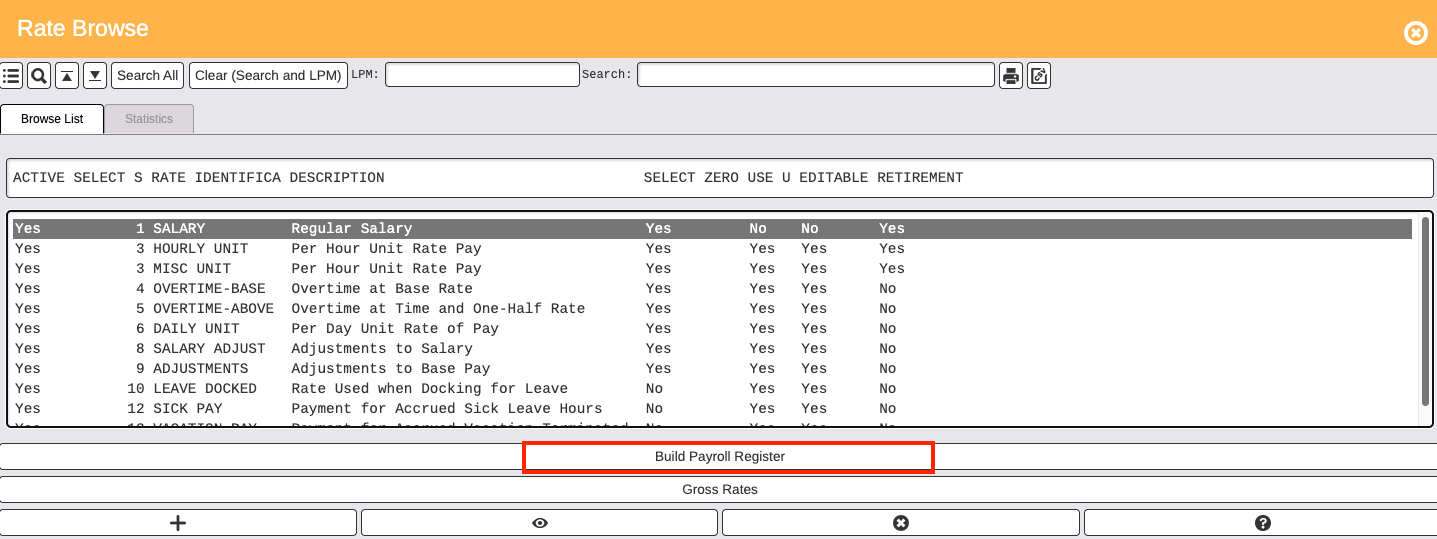
- Rate Browse Window will open automatically
2. Click Add (+)
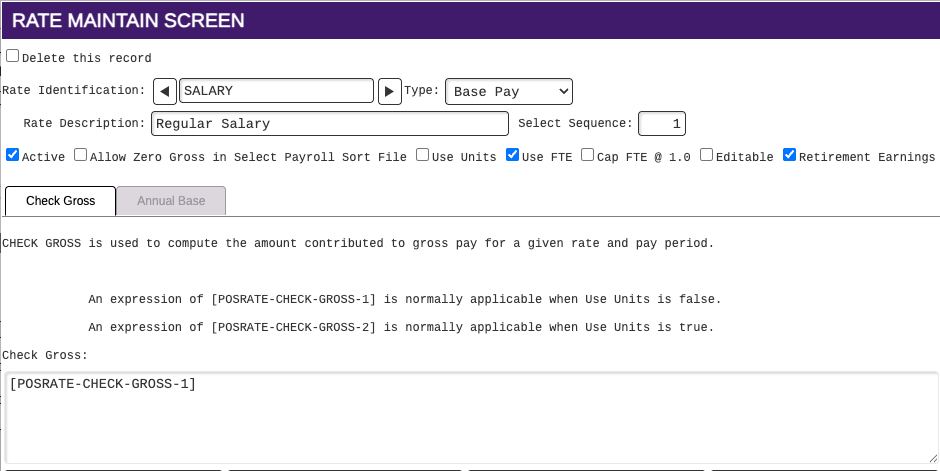
- Rate Maintain Screen Screen will open automatically
FIELDS | Opt. | Rec. | Req. | Description |
| Rate Identification | — | — | ♦ | Enter a Unique Name for the Rate |
| Rate Description | — | — | ♦ | Enter a Description for the Rate |
| Type | — | — | ♦ | Choose the Rate Type Base Pay, Overtime, or Supplemental in the Dropdown (Verify Accuracy - otherwise the Rate may NOT calculate correctly for the Jobs) |
| Select Sequence | — | ♦ | — | Enter the Desired Select Sequence Number (Determines the Sequence in which the Rate will show up in the Select Payroll Process) |
| Active | — | — | ♦ | Select to make the Rate Active |
| Allow Zero Gross in Select Payroll Sort File | ♦ | — | — | Select to Include the Rate in the Pay Jobs in Mass Process for Unit Based Rates and/or when the Rate is Set to ZERO [which results in a ZERO Gross] (Necessary for Hourly, Overtime, or other Unit Based Rates to process in Pay Jobs in Mass) |
| Use Units | ♦ | — | — | Select to Allow the Use of Units |
| Use FTE | ♦ | — | — | Select to Allow the Use of FTE |
| Cap FTE @ 1.0 | ♦ | — | — | Select to Allow the FTE to be CAPPED at 1.0 |
| Editable | ♦ | — | — | Select to Allow the Rate to be EDITABLE at the time of Paying Jobs (Ex: Changing the Rate for Hourly or Daily Paid Jobs for Exceptions) |
| Retirement Earnings | ♦ | — | — | Select to Exclude the Rate from Retirement Earnings |
| Opt. = Optional Rec. = Recommended Req. = Required | ||||
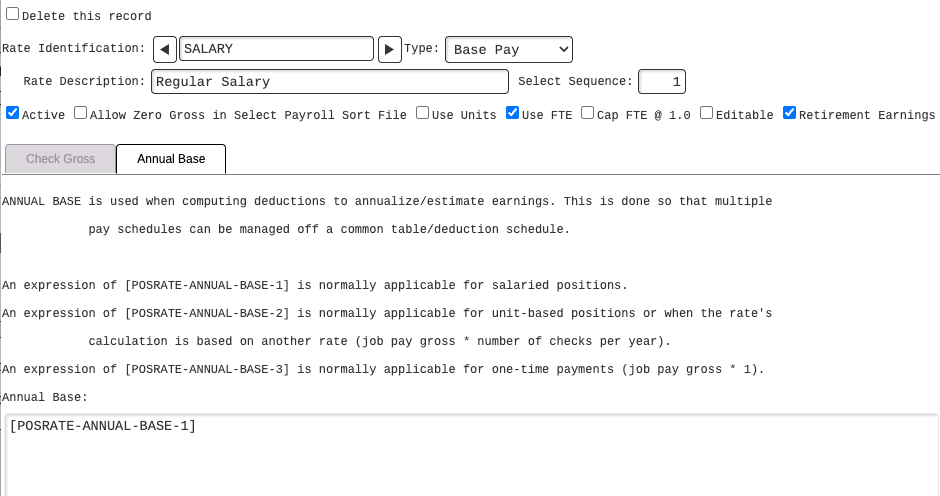
2. Check Gross and Annual Base tabs - If the new rate was added by using an existing rate (recommended), these two tabs will be populated. Ensure that the Check Gross field is correct per the expression information provided whether the rate is paid by units (Use Units is true), or not paid by units (Use Units is false).
Ensure that the Annual Base is correct per the expressions based on salaried, unit-based or one-time payment.
A rate that is set as a one-time payment will not annualize the paid amount for taxation purposes. The paid amount will be the annualized amount.
If the new rate was not added using an existing rate, these two tabs will need to be populated. They can be copied from an existing rate and pasted into the new rate master.
3. AFTER ALL INFORMATION IS COMPLETED ~ Click Save
After Rate has been saved, click on Build Payroll Register so the new rate will appear on the Payroll Register. The process is quick and won't produce a report.
Most Rates are taxable, but any Rate Master called REIMBURSEMENT or MILEAGE is automatically set using the STANDARD RATE BLOCK EZ virtual field to be excluded from the gross of any Deduction Description except the DIRECT DEPOSIT deduction type.